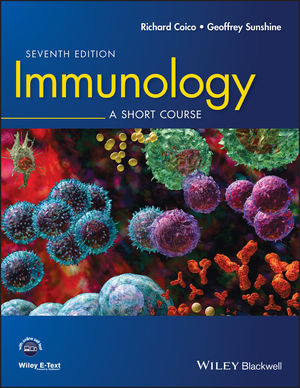
Immunology: A Short Course, Seventh Edition is a concise and accessible textbook that introduces readers to the fundamental concepts of immunology. Written by Richard Coico and Geoffrey Sunshine, the book is designed for students who need a clear understanding of how the immune system functions without becoming overwhelmed by excessive technical detail. It is particularly useful for students in medicine, biology, nursing, pharmacy, and other health-related fields.
One of the book’s main strengths is its organization. The chapters progress logically from basic principles, such as the cells and organs of the immune system, to more complex topics, including immune responses, antibodies, cytokines, hypersensitivity, autoimmunity, immunodeficiency, and transplantation. This structure makes the material easier to follow because readers can build their knowledge gradually. Important concepts are explained in a straightforward manner, which makes the book suitable for both beginners and students reviewing immunology.
Another positive feature is the book’s emphasis on connecting basic immunological mechanisms with clinical applications. Rather than presenting immunology as purely theoretical, the authors demonstrate how immune processes relate to diseases and medical conditions. This approach helps students understand why immunology is important in healthcare and how abnormalities in immune function can contribute to disease. The clinical perspective also makes the subject more interesting and relevant.
The illustrations and diagrams are another helpful aspect of the textbook. Immunology involves many complicated processes and interactions between cells, molecules, and signaling pathways, so visual explanations can make these ideas easier to understand. The figures support the written material and help readers visualize processes that might otherwise seem abstract.
However, the book also has some limitations. Because it is intentionally designed as a “short course,” some topics may not be explored as deeply as they would be in a more comprehensive immunology textbook. Students who want detailed information about advanced molecular mechanisms may need to consult additional references. Some sections can also feel information-heavy, especially for readers encountering immunology for the first time.
Overall, Immunology: A Short Course, Seventh Edition is an effective introductory textbook. Its clear explanations, logical organization, useful illustrations, and clinical focus make it a practical resource for learning the foundations of immunology. Although it may not provide enough depth for advanced study by itself, it succeeds in presenting a complicated subject in a manageable way. I would recommend this book to students who want to develop a strong basic understanding of the immune system and its role in health and disease. It works especially well as a primary study resource, while more specialized textbooks and research articles can be used to expand knowledge of particular topics. For beginners, its balance between scientific accuracy, simplicity, and clinical relevance makes it a valuable and approachable introduction to immunology. The seventh edition therefore remains a useful choice for students preparing for examinations or building foundational knowledge for future studies.