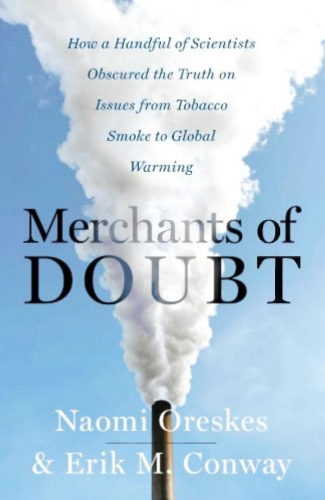
Merchants of Doubt: How a Handful of Scientists Obscured the Truth on Issues from Tobacco Smoke to Global Warming is a compelling investigation into the history of scientific controversy, public debate, misinformation, and organized doubt. The book examines how a small group of influential scientists and public figures challenged established scientific findings on several major issues, creating uncertainty and confusion among policymakers and the public.
Scientific research plays an important role in helping societies understand risks, develop policies, and make informed decisions. However, scientific evidence can sometimes become the subject of intense public and political debate. Merchants of Doubt explores how uncertainty can be deliberately emphasized and how debates over evidence can influence public understanding and government action.
One of the book’s central themes is the manufacturing of doubt. The authors examine historical cases in which questions about scientific evidence were repeatedly raised even as research accumulated. Rather than focusing only on whether individual claims were correct, the book investigates the strategies used to challenge scientific consensus and the broader consequences of prolonged public uncertainty.
The book begins with the history of tobacco and smoking research, examining how scientific debates about the health effects of tobacco developed. It then connects this history to other controversial issues, including acid rain, ozone depletion, secondhand smoke, and climate change. By comparing these cases, the authors identify recurring patterns in how scientific findings can be disputed and how doubt can become a powerful tool in public debate.
Another important subject is the relationship between science, politics, and industry. Scientific questions do not exist in isolation from society. Economic interests, political priorities, lobbying, media coverage, and public opinion can all influence how scientific information is communicated and interpreted. The book explores these connections to show why debates about science can become complicated and highly consequential.
Merchants of Doubt is particularly relevant to readers interested in climate change, tobacco history, scientific misinformation, public policy, environmental history, science communication, and political influence. It provides a historical perspective on how disputes over scientific evidence can affect public understanding and delay responses to significant problems.
The book also encourages readers to think critically about the difference between genuine scientific uncertainty and manufactured controversy. Science naturally involves questioning, testing, and revising ideas. However, the authors explore how the language of uncertainty can be used strategically to create the impression that strong evidence is still inconclusive.
For students, researchers, journalists, educators, environmental professionals, and general readers, Merchants of Doubt offers valuable insight into the relationship between scientific evidence and public discourse. Its historical approach helps readers recognize patterns that can appear whenever scientific findings have important economic or political consequences.
If you are searching for a science and politics book, climate change book, tobacco history book, misinformation book, scientific controversy resource, environmental history book, or science communication guide, Merchants of Doubt provides a fascinating examination of how doubt can shape public debates.
Ultimately, the book raises important questions about how societies evaluate evidence and make decisions in the face of uncertainty. It demonstrates why understanding the history of scientific controversies is essential for recognizing misleading arguments and evaluating claims more carefully.
By connecting debates about tobacco smoke, environmental issues, and global warming, Merchants of Doubt offers a powerful look at the intersection of science, politics, communication, and public trust. It encourages readers to examine the evidence behind controversial claims and to consider how the deliberate creation of uncertainty can influence decisions with consequences that extend far beyond the original scientific debate.