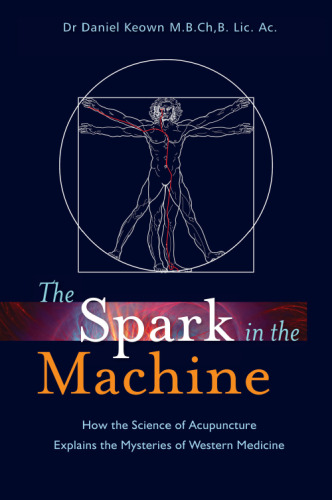
The Spark in the Machine: How the Science of Acupuncture Explains the Mysteries of Western Medicine by Dr. Daniel Keown is a thought-provoking exploration of the connections between acupuncture, Chinese medicine, Western medicine, anatomy, embryology, and modern science. Published by Singing Dragon in 2014, this accessible and engaging book challenges readers to reconsider how the human body works and how traditional Chinese medical concepts may be understood alongside contemporary scientific ideas.
At the heart of The Spark in the Machine is a fascinating question: can modern science help explain some of the concepts that have shaped Chinese medicine for thousands of years? Keown explores ideas such as Qi, acupuncture points, energy pathways, Yin and Yang, embryological development, regeneration, neural crest cells, fascia, nerves, hormones, and biological electricity. Rather than treating Eastern and Western medicine as completely separate systems, he investigates where their concepts may overlap and how an integrated perspective can broaden our understanding of human physiology.
The book begins with intriguing questions about regeneration and the body’s ability to develop and repair itself. Keown considers why some animals can regenerate body parts while humans have much more limited regenerative abilities. From there, he takes readers into the science of embryology and explores how the body develops from a single cell into a complex organism. These discussions provide a foundation for understanding his interpretation of Chinese medicine and its traditional descriptions of the body’s development and organization.
For readers interested in acupuncture, Traditional Chinese Medicine, integrative medicine, alternative medicine, anatomy, physiology, embryology, holistic health, and medical science, this book offers a distinctive perspective. Keown explains complicated subjects in an approachable and often humorous style, making the material accessible to general readers as well as people with an interest in healthcare and complementary medicine.
A significant part of The Spark in the Machine focuses on acupuncture and the body’s interconnected systems. Keown explores acupuncture points and channels while considering their possible relationships to anatomical structures, electrical activity, connective tissues, nerves, and biological signaling. He also examines traditional concepts such as Qi, Jing, Yin and Yang, and the Six Channels, presenting them within a broader discussion of physiology and human development.
The book is divided into major sections covering the science of acupuncture, the embryology of Chinese medicine, and Ming Men and the Six Channels. It also includes appendices discussing subjects such as cancer movement, Yin and Yang, and referred or radiating pain. This structure allows readers to move from fundamental scientific questions toward a broader examination of Chinese medical theory.
One of the book’s most interesting qualities is its attempt to create a dialogue between two different medical traditions. Instead of simply presenting acupuncture as an alternative to Western medicine, Keown asks whether scientific discoveries can provide new ways of interpreting traditional concepts. His approach encourages readers to think about the human body as a highly interconnected system rather than a collection of isolated organs.
The Spark in the Machine is an excellent choice for anyone searching for acupuncture books, Chinese medicine books, integrative medicine, acupuncture science, mind-body medicine, holistic health, human anatomy, embryology, and the science of Traditional Chinese Medicine. It is particularly appealing to readers who enjoy books that connect ancient medical traditions with modern scientific questions.
Overall, The Spark in the Machine: How the Science of Acupuncture Explains the Mysteries of Western Medicine offers an intriguing journey through medicine, biology, acupuncture, and human development. With its combination of scientific ideas, traditional Chinese medical philosophy, surprising examples, and accessible explanations, Daniel Keown’s book invites readers to explore the human body from a fresh and unconventional perspective.