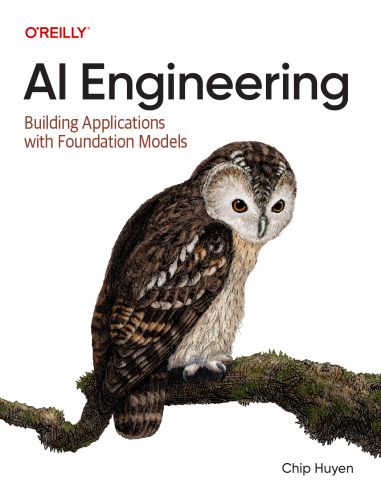
AI Engineering: Building Applications with Foundation Models by Chip Huyen is a practical and comprehensive guide to the rapidly evolving field of AI engineering. As foundation models and generative AI become increasingly accessible, developers and organizations can build powerful artificial intelligence applications without having to train large models from scratch. This book explores the principles, technologies, and engineering practices required to turn foundation models into useful, reliable, and scalable AI products.
AI engineering represents a new approach to application development, combining software engineering practices with modern artificial intelligence capabilities. The book explains how AI engineering differs from traditional machine learning engineering and introduces the emerging AI stack used to build applications with foundation models. Readers can learn how to evaluate AI opportunities, select appropriate models, design application architectures, and address practical challenges throughout the development lifecycle.
A major strength of AI Engineering is its coverage of foundation models, including their capabilities, limitations, training data, model architecture, post-training techniques, sampling strategies, and structured outputs. Understanding these fundamentals helps developers make better decisions when selecting and integrating AI models into real-world applications.
The book also explores essential AI application development techniques, including prompt engineering, retrieval-augmented generation (RAG), agents, fine-tuning, and dataset engineering. These methods allow developers to adapt foundation models for specific use cases and create applications that can provide more relevant, useful, and context-aware results.
Another important focus is AI evaluation. Because generative AI systems can produce unpredictable or incorrect outputs, evaluating quality, reliability, instruction following, cost, latency, and domain-specific performance is essential. The book examines evaluation methodologies, benchmarks, metrics, and approaches such as AI-assisted evaluation, helping readers think critically about the performance of AI systems.
Readers will also discover practical considerations for AI inference optimization and production architecture. Topics include model optimization, inference performance, latency reduction, cost management, caching, model routing, guardrails, monitoring, observability, agent patterns, and user feedback. These concepts are particularly valuable for developers who want to move beyond experimentation and build AI applications capable of operating effectively in real-world environments.
This book is suitable for software engineers, AI engineers, machine learning professionals, data scientists, developers, technical leaders, and technology enthusiasts interested in building modern AI applications. It can also serve as a valuable resource for professionals transitioning from traditional software or machine learning development into the emerging field of AI engineering.
Whether you are interested in generative AI, foundation models, large language models, prompt engineering, RAG, AI agents, fine-tuning, dataset engineering, or production AI systems, AI Engineering: Building Applications with Foundation Models provides a valuable framework for understanding how these technologies fit together.
SEO Keywords: AI Engineering, AI Engineering book, Building Applications with Foundation Models, foundation models, generative AI, artificial intelligence, machine learning, AI applications, LLM engineering, prompt engineering, RAG, retrieval augmented generation, AI agents, fine-tuning, dataset engineering, AI evaluation, inference optimization, AI architecture, machine learning engineering, and AI development.