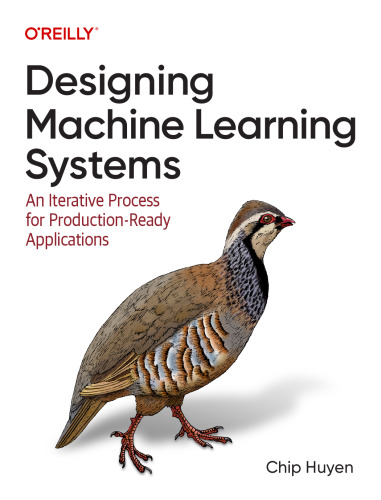
Designing Machine Learning Systems: An Iterative Process for Production-Ready Applications is a practical guide to building reliable, scalable, and production-ready machine learning systems. While many resources focus primarily on machine learning algorithms and model training, this book explores the broader engineering challenges involved in taking machine learning projects from experimental prototypes to dependable applications used in real-world environments. It is an valuable resource for machine learning engineers, data scientists, software developers, and technology professionals.
Modern machine learning engineering requires much more than selecting an algorithm and achieving a high accuracy score. Successful AI applications depend on data quality, system architecture, model evaluation, deployment strategies, monitoring, maintenance, and continuous improvement. This book presents machine learning development as an iterative process, helping readers understand how individual components work together to create robust production systems.
Readers can explore essential concepts related to data engineering, feature engineering, model development, model deployment, and machine learning operations (MLOps). The book emphasizes practical considerations that arise when machine learning models operate in production, including changing data distributions, evolving user behavior, performance degradation, scalability, reliability, and reproducibility.
A major focus is the importance of designing the complete machine learning workflow rather than treating the model as an isolated component. Readers can learn how to define business and technical objectives, collect appropriate data, establish meaningful evaluation metrics, prepare training datasets, build models, and create systems that can continuously improve over time. This approach helps organizations develop AI solutions that deliver measurable value instead of simply producing experimental results.
The book also examines machine learning system architecture and the infrastructure required to support production applications. Topics such as data pipelines, model serving, deployment, monitoring, feedback loops, and system maintenance provide valuable insight into the realities of operating AI systems at scale. Readers gain a better understanding of why a successful machine learning project requires collaboration between data science, software engineering, data engineering, and product teams.
Another important subject is model evaluation and monitoring. A model that performs well during development may behave differently after deployment. Changes in incoming data, user interactions, and real-world conditions can affect prediction quality. Understanding how to monitor models and identify performance problems is therefore essential for maintaining reliable machine learning applications.
The iterative approach presented in this book encourages continuous experimentation and improvement. Instead of assuming that a machine learning system is finished once a model is trained, readers learn to view production AI as an ongoing process involving feedback, testing, optimization, and refinement.
Designing Machine Learning Systems is particularly useful for anyone who wants to understand the practical side of production machine learning. It provides valuable knowledge for professionals building recommendation systems, predictive analytics platforms, fraud detection applications, search systems, personalization engines, and other AI-powered products.
Whether you are an aspiring machine learning engineer, experienced data scientist, software developer, or technical leader, this book can help you develop a stronger understanding of how to transform machine learning models into dependable products. By focusing on data, infrastructure, deployment, evaluation, monitoring, and iteration, it provides a practical foundation for designing scalable machine learning systems and production-ready AI applications.