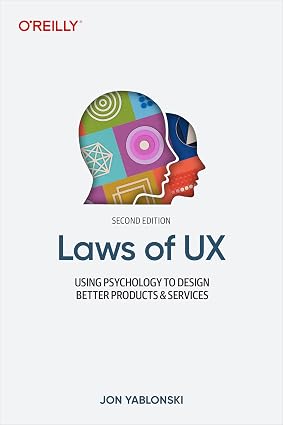
Laws of UX: Using Psychology to Design Better Products & Services by Jon Yablonski is a practical and insightful guide that bridges psychology and user experience design. Now available in an updated second edition, this O’Reilly book shows designers how to create more intuitive, human-centered digital products by understanding the psychological principles that shape how people perceive, process, and interact with interfaces. Yablonski argues that psychology is one of the most valuable non-design skills a designer can possess. Even the most elegant interface can fail if it forces users to adapt to the design rather than working with the natural “blueprint” of human perception and cognition. By applying proven psychological principles, designers can reduce friction, improve usability, and build experiences that feel effortless.
The book explores a carefully selected set of influential laws and effects, including Jakob’s Law (users prefer interfaces that work like those they already know), Fitts’s Law (the time to reach a target depends on its size and distance), Hick’s Law (decision time increases with the number and complexity of choices), Miller’s Law (limits of working memory), the Aesthetic-Usability Effect (beautiful designs are perceived as more usable), the Peak-End Rule, Postel’s Law, Tesler’s Law, the Doherty Threshold, and others. Each principle is clearly explained, supported by real-world examples from familiar apps and digital experiences, and connected to practical design implications. Readers learn how these psychological concepts relate to classic UX heuristics and predictive models. The book also addresses the ethical responsibilities that come with using psychology in design, reminding practitioners that the power to influence user behavior must be exercised thoughtfully and responsibly.
A key strength of Laws of UX is its actionable approach. Beyond explaining the principles, Yablonski provides a practical framework for integrating psychology into the design process. The updated edition deepens the connection to underlying psychological research and includes additional UX methods and techniques, along with refreshed examples that remain relevant to today’s digital landscape.
Whether you are a UX designer, product designer, interaction designer, or anyone involved in creating digital products and services, this book offers clear, accessible guidance. It helps both beginners build a strong foundation and experienced practitioners refine their decision-making with evidence-based insights. In a competitive digital world where user attention is limited and expectations are high, understanding the laws of UX gives designers a powerful advantage. By designing with human psychology in mind rather than against it, teams can create products that are not only functional but genuinely easier and more enjoyable to use. Laws of UX is an essential resource for anyone committed to building better, more human-centered experiences.