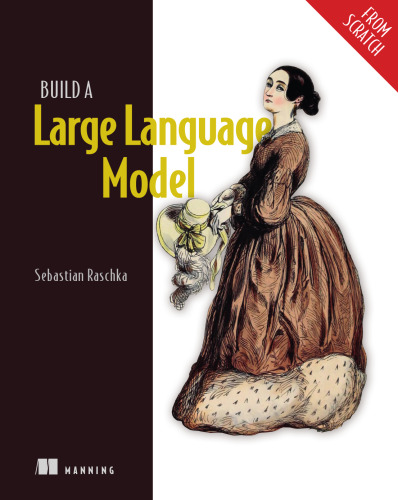
Build a Large Language Model is a practical and accessible guide for readers who want to understand how modern large language models (LLMs), generative AI, and transformer-based artificial intelligence systems are designed and developed. Instead of treating AI as a mysterious black box, this book takes readers through the fundamental concepts and practical techniques behind building a language model from the ground up. It is an excellent resource for Python programmers, machine learning engineers, data scientists, AI developers, students, and technology enthusiasts.
Large language models have transformed the field of artificial intelligence by enabling systems to generate text, answer questions, summarize information, translate languages, write code, and interact with users through natural language. Understanding how these systems work requires knowledge of machine learning, deep learning, natural language processing, neural networks, and transformer architecture. This book provides a hands-on path for exploring those essential technologies.
Readers can learn how text is transformed into numerical representations that computers can process. The book introduces important concepts such as tokenization, embeddings, datasets, attention mechanisms, and neural network architecture. These building blocks help explain how language models learn patterns from text and generate coherent sequences of language.
A key area of focus is the transformer architecture, which has become fundamental to modern generative AI. Readers can explore how attention mechanisms allow models to identify relationships between words and tokens within a sequence. Understanding these principles provides valuable insight into the technologies behind today’s advanced language and conversational AI systems.
The book also explores the practical process of training a large language model. Readers can develop an understanding of preparing training data, implementing neural network components, calculating model outputs, optimizing parameters, and evaluating model performance. These concepts provide a foundation for understanding why high-quality datasets, computational resources, and carefully designed training procedures are essential for successful AI development.
Beyond pretraining, the book introduces techniques for adapting language models to specific tasks and applications. Readers can learn how trained models can be used for text generation and other natural language processing tasks. This practical perspective helps connect theoretical machine learning concepts with real-world generative AI applications.
Programming and experimentation play an important role throughout the learning process. By working through practical examples, readers can strengthen their understanding of Python, PyTorch, neural networks, and deep learning workflows. The hands-on approach makes complex AI concepts more approachable while encouraging readers to experiment and build their own systems.
Build a Large Language Model is valuable for anyone seeking a deeper understanding of how generative AI works beneath the surface. It can serve as a useful learning resource for aspiring AI engineers, machine learning practitioners, software developers, researchers, and students interested in the rapidly evolving field of artificial intelligence.
Whether your goal is to learn how to build an LLM, understand transformer models, explore natural language processing, or develop practical generative AI skills, this book provides a strong technical foundation. By connecting fundamental theory with hands-on implementation, it helps readers move beyond simply using AI tools and toward understanding the technologies that make modern language models possible.
With its focus on large language models, transformers, deep learning, natural language processing, generative AI, neural networks, Python, and model training, this book is an essential resource for readers who want to explore the architecture and development of intelligent language systems.